Python full stack Course in Calicut

AI Integrated Python Full Stack Development

Python Full Stack Developer Course in Calicut

Full Stack Developers who can build and manage both front-end and back-end applications are in high demand. Techolas Technologies offers an AI Integrated Python Full Stack Development course in Calicut, combining industry-relevant programming skills with Generative AI tools and intelligent development practices


Learn to build modern, scalable web applications using Python, frontend technologies, databases, and AI-powered development tools. Gain practical experience in integrating AI into real-world software development workflows.


Choosing the right technology will help you build a future-ready career. With AI transforming the software industry, this course prepares you to become an AI-ready Full Stack Developer.


360 hours on-demand training

50 hours projects

Capstone Projects

⁠60 hours of pre-placement program

Certificate of completion

Our Certifications

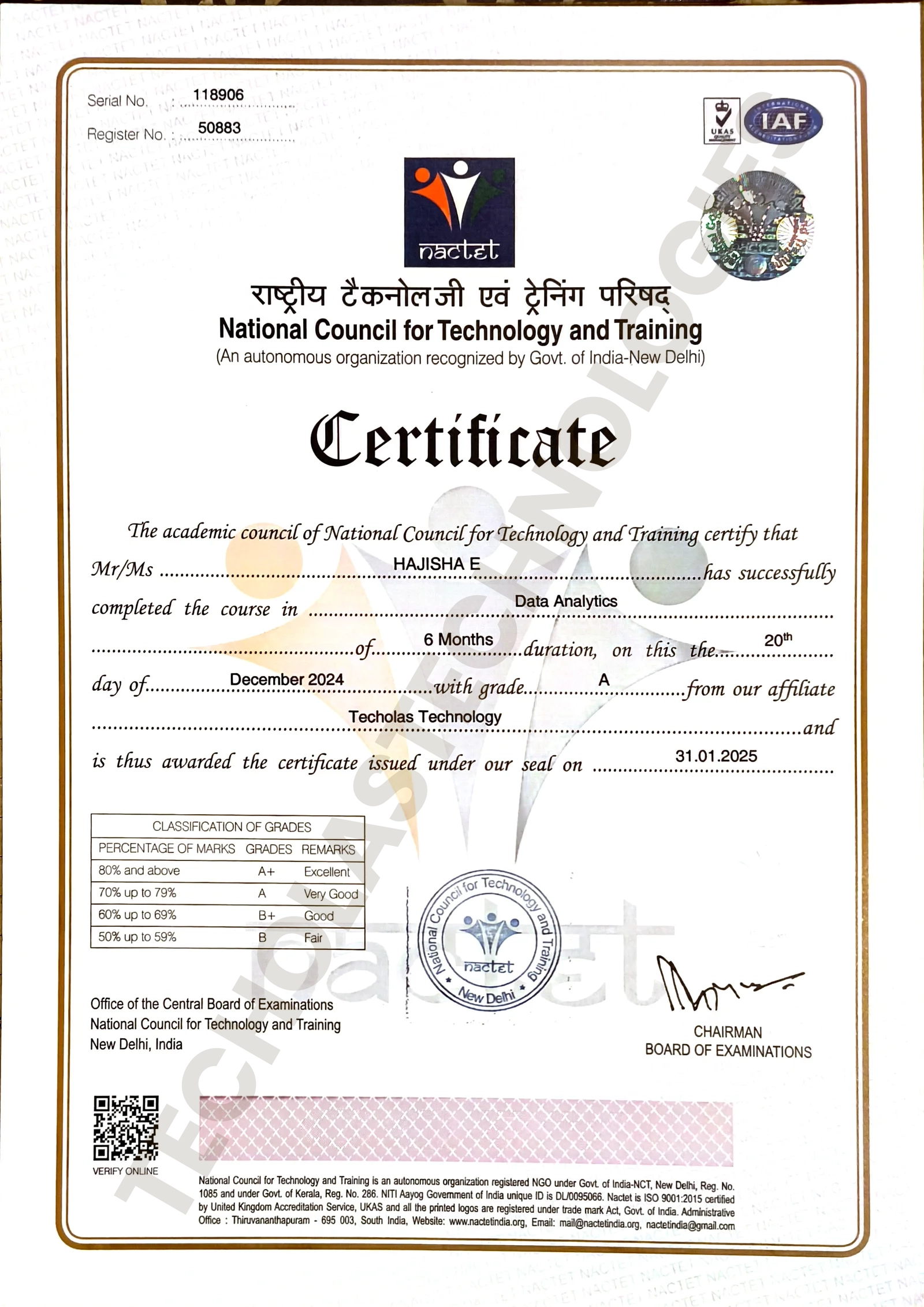
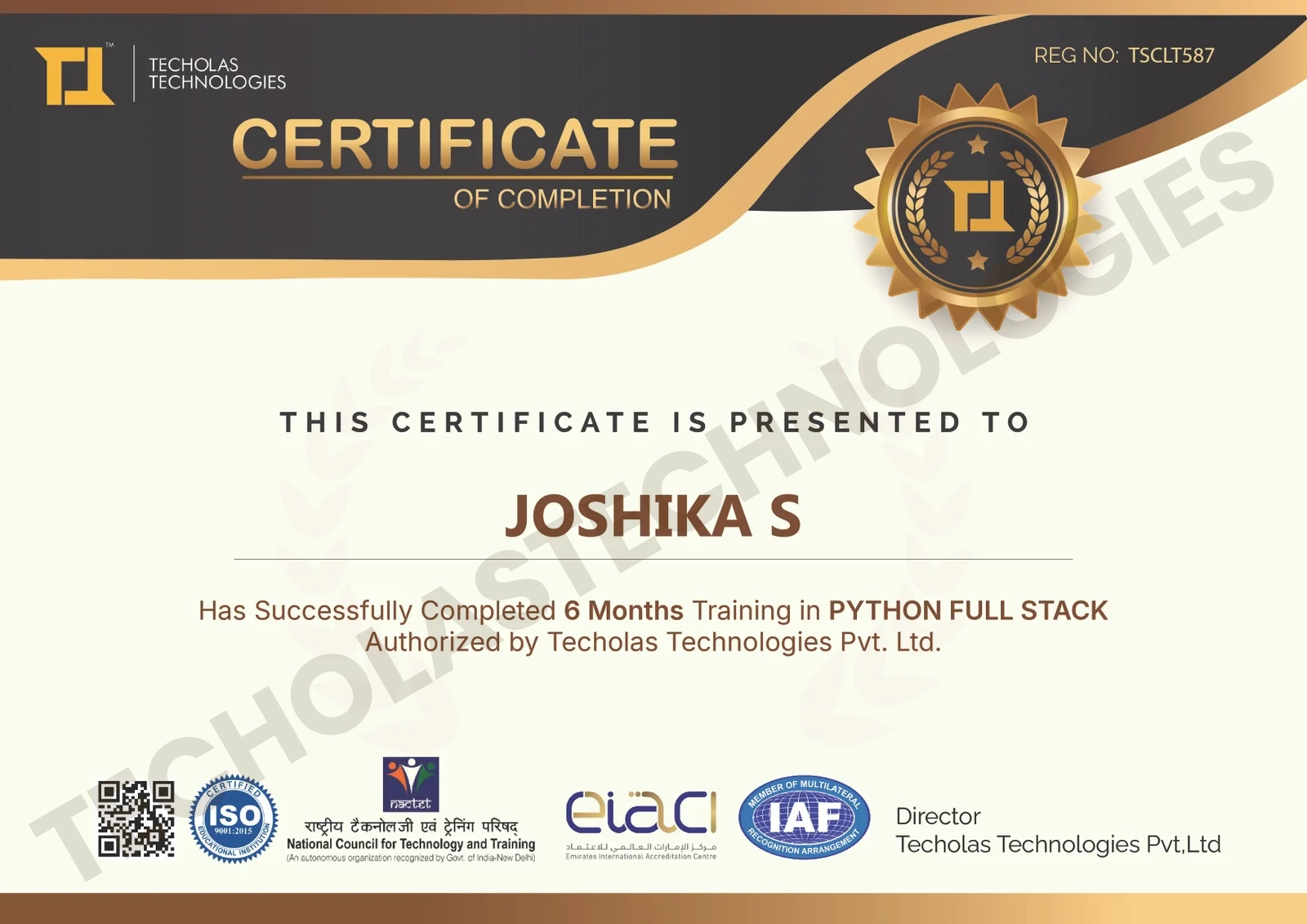
After the completion of your course under our trainers, you will be provided with a total of three certifications which includes- NACTET which has affiliation over 100 and more countries, a certificate of completion and an internship certificate.
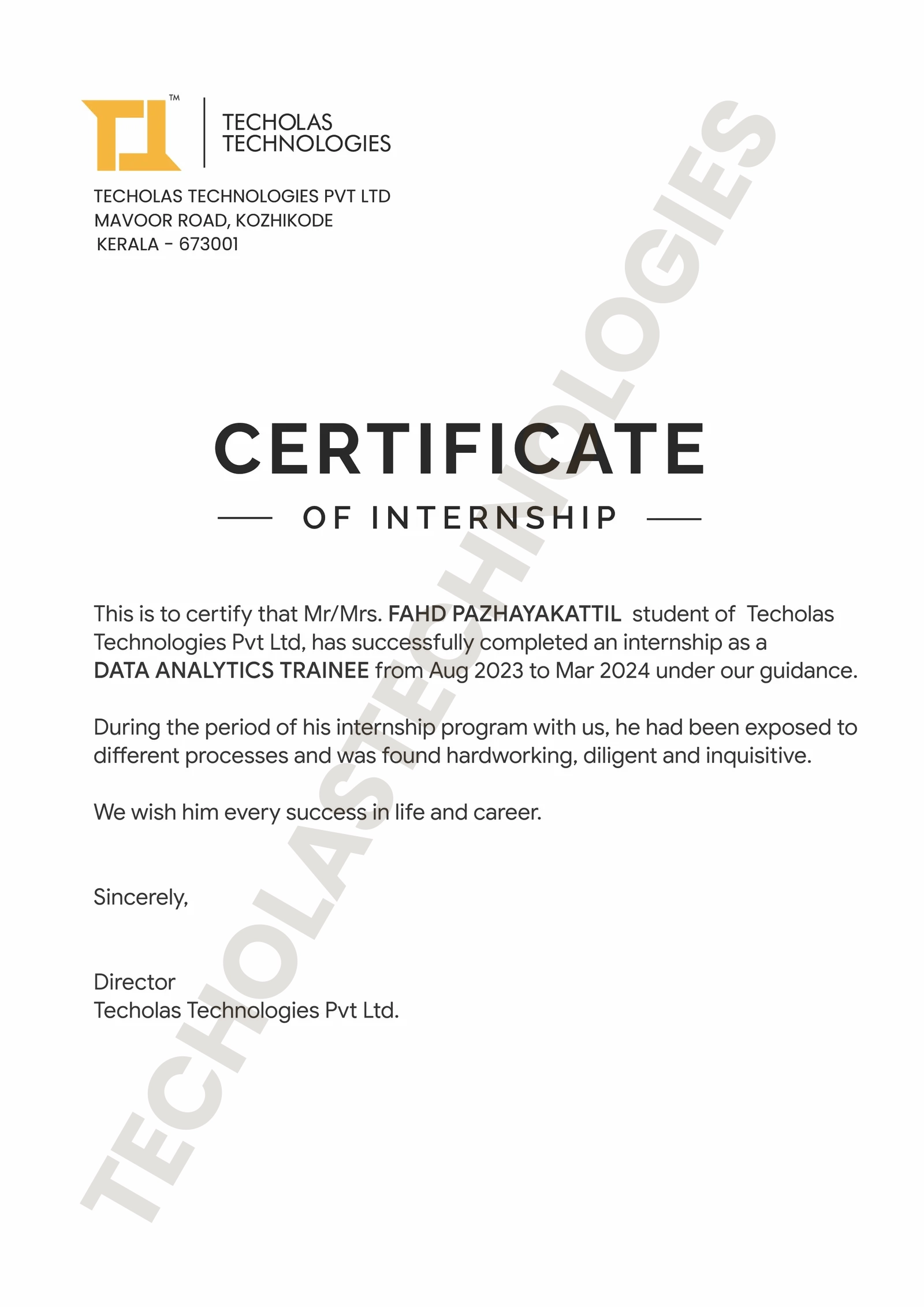
Full Stack Development Internship Certificate
Full Stack Development Completion Certificate
Full Stack Development NACTET Certificate
AI Integrated Python Full Stack Development with Django and React.js

AI Integrated Python Full Stack Developer Course in Calicut

Our AI Integrated Python Full Stack Development course at Techolas Technologies is designed to prepare aspiring developers for the evolving software industry. This program combines strong foundations in Python programming, modern web development, and Generative AI technologies to help learners build dynamic, scalable, and intelligent web applications.

The course covers complete front-end and back-end development. Students gain hands-on experience with HTML, CSS, JavaScript, and React.js to create responsive and interactive user interfaces. On the back-end, learners work with Python and Django to develop secure, scalable, and high-performance web applications with database integration and REST API development.

AI & Generative AI Integration

Go beyond traditional software development by exploring Generative AI tools and AI-powered development workflows. Learn how to use AI assistants for code generation, debugging, code optimization, documentation, and improving development productivity. Understand how to integrate AI APIs and intelligent features into web applications to build smarter digital solutions.

Practical Learning & Industry Exposure

Through hands-on coding, practical assignments, and real-world industrial projects, students develop the ability to design, develop, test, and deploy complete web applications. The program also introduces modern development practices, Git and GitHub, API integration, database management, and application deployment.

Modern AI-Powered Development Practices

Students will explore how AI is transforming the software development lifecycle, from planning and designing applications to coding, testing, and deployment. They will gain practical exposure to AI-powered development assistants, intelligent debugging, automated code suggestions, and prompt engineering techniques to improve productivity and build efficient software solutions.

Career Readiness & Future Opportunities

The program focuses on developing both technical expertise and industry-ready skills through practical projects, problem-solving activities, and real-world application development. With a combination of Python Full Stack Development and Generative AI knowledge, learners will be prepared to explore career opportunities as Python Full Stack Developers, Backend Developers, Web Application Developers, and AI-Integrated Software Developers.

By combining full-stack development expertise with AI-powered technologies, learners gain the technical skills and practical confidence required to build future-ready applications and pursue opportunities in the modern IT industry.


Why you should prefer Techolas Technologies ?

Choosing Techolas Technologies for the AI-Integrated Python Full Stack Development Course gives you a decisive career advantage in a tech industry rapidly shifting toward intelligent applications, as this 7-month intensive program embeds modern Artificial Intelligence directly into end-to-end software engineering rather than treating it as an afterthought. Designed to be completely beginner-friendly even without a computer science background, the curriculum takes you step-by-step from core programming fundamentals to mastering frontend technologies (HTML, CSS, JavaScript, Bootstrap, React.js), scalable backends (Python, Django, Flask), databases (PostgreSQL, MongoDB), cloud deployment (AWS), and real-world AI integration using LLM APIs and prompt engineering.

Modules

PHASE 1 :FRONTEND DEVELOPMENT

Module 1: HTML, CSS, TAILWIND CSS & GIT

  • Web Fundamentals and HTML Essentials
  • Introduction to how the web works, HTTP/HTTPS and request-response cycles.
  • Understanding browser rendering and HTML document structure.
  • HTML elements, headings, paragraphs, text formatting and attributes.
  • Working with hyperlinks, images, lists and tables.
  • HTML forms, input types and form validation.
  • Semantic HTML5 elements and webpage structure

CSS Fundamentals

  • CSS selectors, specificity and pseudo-classes.
  • CSS box model, margins, padding and borders.
  • Display properties and positioning techniques.
  • Colours, typography, fonts and measurement units.
  • Static, relative, absolute, fixed and sticky positioning.
  • Flexbox layouts and alignment techniques.
  • CSS variables and z-index management.

CSS Grid, Tailwind CSS and Git

  • CSS Grid layouts and responsive page structures.
  • Responsive web design and mobile-first development.
  • Media queries and responsive breakpoints.
  • Introduction to Tailwind CSS and utility-first styling.
  • Tailwind CSS installation and configuration.
  • Responsive utilities, hover, focus and dark mode.
  • Git fundamentals, repository management and version control.
  • GitHub repositories, feature branches and project deployment.

MODULE 2 :JAVASCRIPT & TYPESCRIPT

JavaScript Core Language

  • Introduction to JavaScript and programming fundamentals.
  • Variables, data types, type conversion and type coercion.
  • Operators, conditional statements and looping structures.
  • Functions, arrow functions and default parameters.
  • Scope, closures and hoisting concepts.
  • Arrays and array manipulation methods.
  • Working with map, filter, reduce, find and forEach methods

Objects, DOM and Events

  • JavaScript objects and destructuring.
  • Spread and rest operators.
  • Set and Map data structures.
  • Constructor functions and the this keyword.
  • DOM fundamentals and HTML document manipulation.
  • Selecting and modifying HTML elements.
  • Event handling using click, input, submit and keyboard events.
  • Event propagation and DOM manipulation techniques.
  • Developing a JavaScript-based To-Do List application.

Asynchronous JavaScript and Fetch API

  • Introduction to synchronous and asynchronous programming.
  • Callback functions and callback patterns.
  • JavaScript Promises and promise chaining.
  • Async and Await concepts.
  • Error handling using try, catch and finally.
  • Fetch API and HTTP GET/POST requests.
  • JSON data handling and API integration.
  • CORS concepts and API error handling.
  • Developing applications using public APIs.

OOP, Storage and TypeScript

  • Object-Oriented Programming in JavaScript.
  • Classes, constructors, inheritance and methods.
  • Local Storage and Session Storage.
  • JSON data conversion and storage.
  • Introduction to TypeScript and its advantages.
  • Type annotations, type inference and primitive types.
  • TypeScript interfaces, type aliases and union types.
  • Optional properties and generic types.
  • Converting JavaScript applications into TypeScript.

MODULE 3: REACT WITH TYPESCRIPT & NEXT.JS

React Fundamentals with TypeScript

  • Introduction to React.js and its architecture.
  • Setting up React projects using Vite.
  • Understanding JSX and TSX.
  • Developing reusable functional components.
  • Component properties and TypeScript interfaces.
  • Lists, keys and conditional rendering.
  • Styling React applications using CSS Modules and Tailwind CSS.

React Hooks, State and Effects

  • Introduction to React Hooks.
  • State management using useState.
  • Managing complex states using useReducer.
  • Controlled components and form handling.
  • Component communication and lifting state.
  • Side effects using useEffect.
  • DOM references using useRef.
  • Developing custom React Hooks.
  • React DevTools and component debugging.

Routing, Context API and Forms

  • React Router v6 and application navigation.
  • Dynamic routing and protected routes.
  • Navigation using useNavigate and useParams.
  • State management using Context API.
  • Form handling using React Hook Form.
  • Form validation and error handling.
  • API integration using Axios.
  • JWT token attachment and API interceptors.
  • Error boundaries and accessibility fundamentals.

Redux Toolkit, React Query and Performance

  • Introduction to Redux Toolkit.
  • Store configuration, slices, actions and reducers.
  • State management using useSelector and useDispatch.
  • Middleware fundamentals.
  • Server-state management using TanStack React Query.
  • Data fetching, caching and background refetching.
  • Performance optimisation using useMemo and useCallback.
  • Code splitting using React.lazy and Suspense.
  • Component documentation using Storybook.
  • Introduction to CI/CD using GitHub Actions.

Next.js App Router

  • Introduction to Next.js and its architecture.
  • App Router and Pages Router.
  • File-based routing and project structure.
  • Server Components and Client Components.
  • Server-side data fetching.
  • Route handlers and API development.
  • Image optimisation using next/image.
  • SEO and Metadata API.
  • Deployment using Vercel.
  • Understanding Zustand and Context API.

PHASE 2 – BACKEND DEVELOPMENT

MODULE 4: PYTHON PROGRAMMING & POSTGRESQL

    Week 13 – Python Syntax, Control Flow, Data Structures and Functions

    • Introduction to Python programming and its syntax.
    • Python data types, variables and type hints.
    • Conditional statements and nested conditions.
    • Loops and control statements.
    • Python collections including Lists, Tuples, Dictionaries and Sets.
    • List comprehensions and dictionary comprehensions.
    • Functions, modules and lambda expressions.
    • Working with map() and filter() functions.
    • Introduction to Object-Oriented Programming.
    • Classes, objects, constructors and inheritance.

    Week 14 – Advanced OOP and Python Concepts

    • Multiple inheritance and Method Resolution Order.
    • Polymorphism and operator overloading.
    • Encapsulation and abstraction.
    • Public, private and protected access concepts.
    • Abstract classes using the ABC module.
    • Generators and iterators.
    • Lazy evaluation and iterator protocols.
    • Advanced exception handling and custom exceptions.
    • Context managers and exception hierarchy.
    • Python programming assignments and AI-assisted code review.

    Week 15 – PostgreSQL Relational Database Design and SQL Fundamentals

    • Introduction to PostgreSQL and database management.
    • PostgreSQL installation and configuration.
    • Database management using pgAdmin 4.
    • PostgreSQL data types and table structures.
    • DDL, DML and DQL commands.
    • Creating, modifying and deleting database records.
    • SELECT queries, filtering, sorting and limiting records.
    • SQL aliases and DISTINCT operations.
    • INNER JOIN, LEFT JOIN and RIGHT JOIN.
    • Relational database design and ER diagrams.
    • Designing an e-commerce database schema.

    Week 16 – Advanced SQL and Database Optimisation

    • SQL aggregate functions including COUNT, SUM, AVG, MIN and MAX.
    • GROUP BY and HAVING clauses.
    • Subqueries and correlated subqueries.
    • Common Table Expressions (CTEs).
    • SQL window functions including ROW_NUMBER, RANK, LAG and LEAD.
    • Database indexing and B-tree indexes.
    • Composite indexes and query optimisation.
    • Understanding EXPLAIN ANALYZE.
    • Introduction to SQL vs NoSQL databases.

    MODULE 5: DJANGO & FLASK FRAMEWORKS

    Django Architecture, ORM and Admin

    • Introduction to Django and its applications.
    • Understanding Django architecture and MVT patterns.
    • Django project and application setup.
    • Project configuration using settings.py and urls.py.
    • Django models and database relationships.
    • Django ORM and PostgreSQL integration.
    • Database migrations and model management.
    • QuerySet API and database operations.
    • Working with filter(), exclude(), select_related() and prefetch_related().
    • Custom model managers and Django Admin customisation.

    Django REST Framework (DRF)

    • Introduction to REST API development using Django REST Framework.
    • Serializers and ModelSerializer.
    • APIView, ViewSets and Routers.
    • REST API development and CRUD operations.
    • Authentication using JWT.
    • Permissions and IsAuthenticated.
    • Custom permission classes.
    • Pagination, filtering and throttling.
    • CORS configuration.
    • Comparing FastAPI and Django REST Framework.

    Flask Microservices and Scripting

    • Introduction to Flask and its applications.
    • Flask application setup and architecture.
    • Flask routes and request handling.
    • URL parameters and JSON request processing.
    • Response generation using jsonify.
    • Error handling and application factories.
    • Database integration using Flask-SQLAlchemy.
    • Working with database sessions and models.
    • Flask Blueprints and application structure.
    • Webhook development and JSON data processing.
    • Introduction to microservices architecture.
    • Understanding monolithic and microservices applications.

    MODULE 6: FASTAPI – MODERN ASYNCHRONOUS REST API DEVELOPMENT

    FastAPI Fundamentals and Pydantic v2

      FastAPI Fundamentals and Pydantic v2

      • Introduction to FastAPI and modern API development.
      • FastAPI installation and project setup.
      • Synchronous and asynchronous API concepts.
      • Route decorators and HTTP methods.
      • GET, POST, PUT, DELETE and PATCH operations.
      • Path parameters and query parameters.
      • Data validation using Pydantic v2.
      • Pydantic models, fields and validators.
      • Response models and HTTP status codes.
      • Exception handling and middleware.
      • Automatic API documentation using Swagger UI and ReDoc.

      Authentication, AWS S3, Docker and CI/CD

      • Authentication using JSON Web Tokens (JWT).
      • JWT token generation and verification.
      • OAuth 2.0 and OpenID Connect fundamentals.
      • Google and GitHub social login integration.
      • Authentication using Authlib and Auth0 concepts.
      • AWS S3 bucket configuration and file storage.
      • File uploads using boto3.
      • Presigned URLs and secure file access.
      • Docker fundamentals and Dockerfile creation.
      • Docker Compose and PostgreSQL integration.
      • Environment variable management.
      • Automated testing using pytest.
      • CI/CD workflows using GitHub Actions.
      • Backend deployment using Railway or Render.

      PHASE 3 – AI INTEGRATION

      MODULE 7: AI INTEGRATION – APIs, RAG, AGENTS & OBSERVABILITY

        AI API Fundamentals

        • Introduction to Large Language Models (LLMs).
        • Understanding tokens, context windows and model parameters.
        • Temperature, Top-P and stop sequences.
        • Introduction to OpenAI API and API key management.
        • Integrating GPT-4o and GPT-4o-mini using Python SDK.
        • Introduction to Anthropic Claude API.
        • Working with Claude Sonnet and Claude Haiku models.
        • Integrating AI APIs with FastAPI.
        • Developing asynchronous AI endpoints.
        • Streaming AI responses using Server-Sent Events (SSE).
        • Connecting AI-powered backend APIs with React applications.

        Multimodal AI and Structured Output

        • Introduction to multimodal Artificial Intelligence.
        • Working with image inputs and vision-based AI applications.
        • Integrating GPT-4o and Claude vision capabilities.
        • Structured output generation using AI models.
        • JSON mode and Pydantic schema validation.
        • Function calling and tool calling concepts.
        • Defining AI tools using JSON schemas.
        • Multi-tool orchestration.
        • AI API error handling and retry mechanisms.
        • Rate limit and authentication error management.
        • Secure API key management.
        • AI usage tracking and cost estimation.

        Prompt Engineering

        • Introduction to Prompt Engineering.
        • Understanding system prompts and user prompts.
        • Designing effective prompts and AI personas.
        • Prompt structure, constraints and output formatting.
        • Few-shot prompting techniques.
        • Chain-of-thought prompting concepts.
        • Token counting using tiktoken.
        • Context window management and conversation summarisation.
        • Prompt injection and security risks.
        • Prompt safety and output sanitisation.
        • Evaluating and improving prompt quality.

        Observability: Sentry, LangSmith and Logging

        • Introduction to AI application observability.
        • Error monitoring using Sentry.
        • Sentry integration with FastAPI.
        • Performance monitoring and automatic error capture.
        • Structured logging using Python.
        • JSON logging and log levels.
        • Tracking AI model usage, tokens and response latency.
        • Introduction to LangSmith.
        • LLM tracing and execution monitoring.
        • Creating evaluation datasets.
        • Automated AI response evaluation.
        • Introduction to n8n workflow automation.
        • Connecting n8n webhooks with FastAPI.

        n8n Automation and Production AI Patterns

        • Introduction to n8n workflow automation.
        • Understanding nodes, workflows and triggers.
        • Webhook-based workflow automation.
        • Integrating OpenAI and Anthropic with n8n.
        • Working with AI Agent nodes.
        • HTTP Request node and API integration.
        • Automated Slack and email notifications.
        • Scheduling workflows using Cron triggers.
        • Error handling and retry mechanisms.
        • JavaScript Function nodes.
        • Semantic caching and embedding similarity.
        • Automating AI application workflows.
        • Production AI application development.

        Embeddings and Vector Databases

        • Introduction to embeddings and vector representations.
        • Understanding semantic similarity and cosine similarity.
        • Generating embeddings using OpenAI Embeddings.
        • Introduction to Cohere embedding models.
        • Understanding vector database architecture.
        • Vector storage and similarity search.
        • Working with Pinecone cloud vector database.
        • Index creation, vector upsert and retrieval.
        • Metadata filtering and top-K search.
        • Introduction to ChromaDB.
        • Working with pgvector in PostgreSQL.
        • Comparing cloud and local vector databases.
        • Developing semantic search applications.

        RAG Pipeline and AI Evaluation Framework

        • Introduction to Retrieval-Augmented Generation (RAG).
        • Understanding RAG architecture and workflow.
        • Document ingestion and processing.
        • PDF processing using PyPDF.
        • Word document processing using python-docx.
        • Web content extraction using BeautifulSoup.
        • Text chunking and document splitting techniques.
        • Fixed-size, sentence-based and recursive chunking.
        • Embedding generation and vector storage.
        • Semantic retrieval and similarity search.
        • Hybrid search using BM25 and vector search.
        • Context assembly and prompt templates.
        • Introduction to RAGAS evaluation framework.
        • Faithfulness, answer relevancy and context recall.
        • Introduction to LangChain and LlamaIndex.
        • Building RAG-based applications.

        Conversational Memory, AI Agents and MCP

        • Introduction to conversational memory.
        • Buffer memory, summary memory and sliding-window memory.
        • Managing chat history and conversation context.
        • Storing user conversation history in PostgreSQL.
        • Advanced LangSmith tracing and RAG debugging.
        • Introduction to AI agents and autonomous workflows.
        • AI agent loops and tool execution.
        • Function calling using OpenAI and Anthropic.
        • ReAct agent architecture.
        • Safe tool design and AI agent security.
        • Introduction to Model Context Protocol (MCP).
        • Understanding MCP architecture and tool connectivity.
        • Exposing FastAPI endpoints as MCP tools.
        • Developing AI applications with conversational memory.